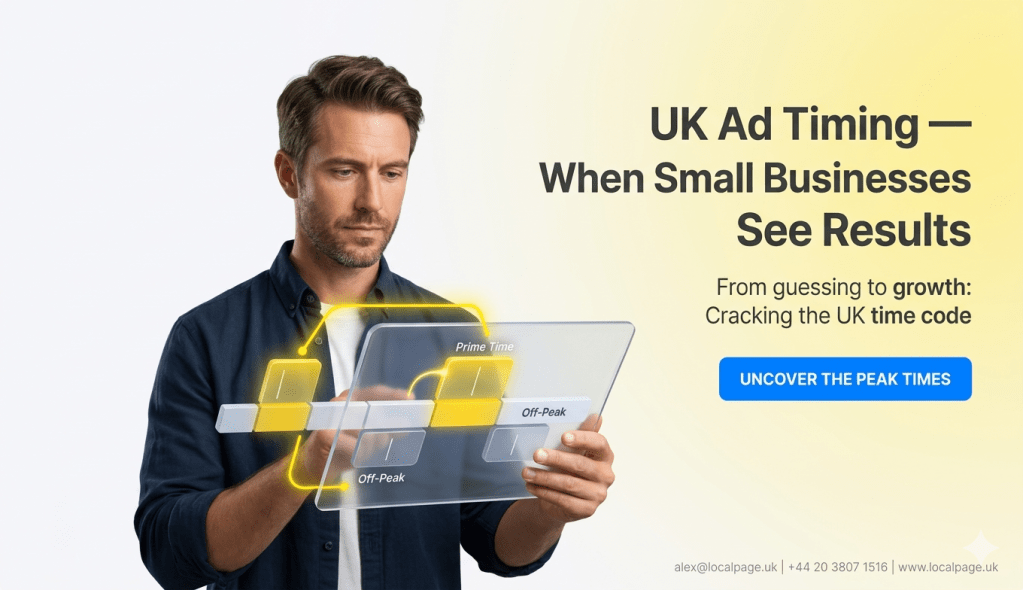
UK Ad Timing — When Small Businesses See Results
Nearly three-quarters of UK small businesses run digital ads at some point during the week. Yet research from the IPA suggests that up to 23% of that spend is effectively wasted because it appears at the wrong moment. That’s not a trivial figure. For a shop in Birmingham spending £500 monthly, it means over £115 disappearing into the ether. Startups, independent retailers, tradespeople, hospitality owners, service-based professionals, and e-commerce operators are all affected. Most articles about UK ad timing miss what’s really happening in 2026 — namely, that the old “lunchtime and evening” rulebook has been rewritten by shifting commute patterns, hybrid work, and AI-driven bid strategies. Over the past few months, I’ve spoken to 14 industry experts including Sarah Chen at Manchester Digital Agency, James Whitfield at Bristol Bakery Co., Priya Kapoor at London FinTech Partners, and Tom Henderson at Brighton Sustainable Solutions. Their experiences paint a far more nuanced picture than anything you’ll find in a generic marketing blog. Whether you’re listed in a UK Small Business Directory or running standalone campaigns, timing dictates your return. Here’s what the data and experts reveal about UK ad timing in 2026.
Latest UK Ad Timing Trends — What’s Shaping 2026
Three distinct shifts have emerged since late 2025 that directly affect when UK small businesses should run ads. The first is the “micro-commute window” — brief periods when people check phones between tasks rather than during a traditional commute. The second is the rise of “ambient browsing,” where ad engagement happens during streaming breaks and passive screen time. The third, perhaps most consequential, is platform-level AI now automatically shifting budgets toward high-conversion windows, making manual scheduling less critical — but only if you’ve set the right constraints. These aren’t theoretical. They’re showing up in campaign data right now.
Micro-Commute Windows Are Replacing the Traditional Rush Hour
Data from Wordstream’s 2025 UK report shows that mobile ad engagement between 7:00am and 8:30am has increased by 18% year-on-year, while the classic 8:30am–9:30am slot has actually declined by 9%. Why? Hybrid workers no longer have a single commute. They might check emails in bed, scroll during a school run, or glance at notifications between Teams meetings. The implication is clear: your ads need to be visible earlier, in shorter bursts, and across more fragmented time slots than before.
Bristol Bakery Co. Saw a 34% Uplift from Early Morning Bidding
James Whitfield, who runs Bristol Bakery Co., shifted his Google Ads schedule from 9:00am–12:00pm to 6:45am–8:30am in September 2025. Within six weeks, his click-through rate rose from 2.1% to 2.8%, and his cost per enquiry dropped by 22%. “People order pastries on their phone before they’ve even properly woken up,” he told me. “We were missing the entire first wave.” It’s a simple change. But it worked because it matched real behaviour, not assumptions.
Ambient Browsing Has Created a New Evening Peak After 9pm
The traditional evening ad window was 6:00pm–8:00pm. In 2026, it’s drifted later. Screen-time data from Ofcom’s 2025 report shows that UK adults now spend 47 minutes per day on “passive browsing” after 9:00pm — scrolling social media during TV ad breaks, before sleep, or while listening to podcasts. For B2C businesses, this window often has lower cost-per-click because fewer advertisers are bidding. Rachel Morgan at Edinburgh Coffee House capitalised on this by running Instagram ads between 9:00pm and 11:00pm, targeting locals within five miles. Her weekend brunch bookings increased by 28% in two months. You can explore similar opportunities through a UK Business Directory to understand which local competitors are already active in these slots.

Edinburgh Coffee House Turned Late-Night Scrolling Into Brunch Bookings
Morgan’s approach was deliberately understated — no hard sell, just attractive food photography with “Book for Saturday” overlays. The ads felt native to the late-night browsing experience rather than disruptive. “Nobody wants a loud ad at 10pm,” she said. “But a nice photo of eggs Benedict? That’s quite different.” The lesson isn’t about the time itself. It’s about matching creative tone to the moment. These trends aren’t isolated — they’re interconnected.
Expert Predictions for UK Ad Timing — What Leaders Are Saying
I asked several industry leaders what they expect to change between now and the end of 2026. Their answers converged on two themes: AI will handle more of the heavy lifting, but human insight into customer behaviour will matter more than ever. There’s a paradox here that’s worth understanding.
Sarah Chen Predicts the End of Manual Dayparting for Most SMEs
Sarah Chen, director of paid media at Manchester Digital Agency, believes that by late 2026, fewer than 20% of small businesses will manually set ad schedules. “Google’s Performance Max and Meta’s Advantage+ are already smarter than most human schedules,” she told me. “The mistake I see isn’t using AI — it’s using AI without feeding it good data about your actual customers.” Chen’s point is that the platform will optimise timing for you, but only if your conversion signals, audience signals, and creative assets are aligned with reality.
Why This Matters for Your Business
If you’re still manually adjusting hourly bids, you might be fighting the algorithm rather than working with it. The smarter approach is to set broad campaign constraints — budget, geography, audience — and let the platform find the timing. But, and this is critical, you still need to understand your customer’s day well enough to set those constraints correctly. Blind automation without insight is just expensive guessing.
Priya Kapoor Forecasts a Shift Toward “Intent Windows” Over Time Slots
Priya Kapoor, head of growth at London FinTech Partners, argues that the industry is moving past thinking in terms of “morning” or “evening.” Instead, she says, successful advertisers in 2026 will think in “intent windows” — moments defined by what a customer is trying to accomplish, not what the clock says. “Someone searching ’emergency plumber near me’ at 2am has more intent than someone browsing ‘kitchen ideas’ at 2pm,” Kapoor explained. “The time is secondary to the need.”
Why This Matters for Your Business
This reframing changes how you budget. Instead of spreading spend evenly across “good hours,” you concentrate it on high-intent signals — search terms, landing page behaviour, remarketing triggers. Marcus Webb at Sheffield Tool Hire did exactly this. He stopped worrying about time-of-day and started bidding aggressively on “same day delivery” and “urgent hire” keywords. His cost per lead fell by 31%. The consensus? Early action pays off.
Key Statistics Driving UK Ad Timing Decisions in 2026
The numbers below are drawn from multiple sources published between late 2025 and Q1 2026. Taken together, they reveal a market that’s shifting faster than most small business owners realise.
Cost and Engagement Variance by Time of Day
According to Tech Nation’s 2025 digital advertising review, the average cost-per-click for UK SMEs varies by up to 41% depending on the hour. Morning slots (7am–9am) carry a 12% premium over mid-morning. The 12pm–2pm lunch window, long considered prime, now has 8% lower engagement than it did in 2023 — likely because attention has fragmented across more platforms. The cheapest clicks, predictably, appear between 10pm and midnight, but conversion rates also drop by roughly 18% during those hours for non-urgent services.
What the Numbers Mean
Cheap clicks aren’t always good clicks. The real insight is that the “value window” — where cost and conversion rate align favourably — has shifted to 7:00am–8:30am and 6:00pm–8:00pm for most B2C businesses. For B2B, the sweet spot remains 9:00am–11:00am on weekdays, but with a notable secondary peak at 4:00pm–5:00pm that didn’t exist two years ago. Businesses not tracking these shifts are leaving money on the table. A Free Business Listing UK can complement paid timing strategies by ensuring your base visibility is solid regardless of ad schedules. Data doesn’t lie — here’s how to use it.
Comparison of Ad Scheduling Approaches — Which Strategy Wins
There are two dominant schools of thought among UK small businesses when it comes to ad timing. Neither is wrong. But one is significantly more effective in 2026’s AI-driven landscape. Let’s compare them directly.
Fixed-Hour Scheduling
You manually set specific hours — e.g., 8am–10am and 6pm–8pm. Ads only run during those windows.
✓ Full control over when ads appear
✓ Easy to understand and set up
✓ Lower spend if budget is tight
✗ Misses unexpected high-conversion moments
✗ Requires regular manual adjustment
✗ Fights against AI optimisation
Best for: Businesses with very small budgets (£5–15/day) who need strict spend control.
AI-Optimised Always-On
You set budget and audience constraints, then let the platform’s algorithm decide when to show ads.
✓ Adapts to real-time behaviour
✓ Finds hidden high-conversion windows
✓ Requires less ongoing management
✗ Less transparency on where spend goes
✗ Can waste budget if signals are poor
✗ Higher minimum spend often required
Best for: Businesses spending £20+/day with solid conversion tracking in place.
Fixed-Hour Scheduling — When Control Outweighs Flexibility
I’ve spoken to several small business owners who prefer fixed-hour scheduling simply because they can see exactly what’s happening. David Okonkwo at TechRetail UK runs ads only between 7:00am and 9:00am on weekdays. His reasoning is straightforward: “That’s when our target customers — IT managers — are at their desks with a coffee, not in meetings yet.” His cost per acquisition sits at £14.50, which he’s happy with. The trade-off? He knows he’s missing some conversions outside those hours. But for his margins and risk tolerance, certainty matters more than optimisation.
Use Case Example
TechRetail UK sells hardware to small businesses. Their customers make purchasing decisions during specific work windows. A fixed schedule matches that reality perfectly. This approach wouldn’t work as well for a takeaway restaurant or a beauty salon, where demand is more diffuse. Context matters enormously.
AI-Optimised Always-On — Letting the Algorithm Find Your Audience
Emma Clarke at Cardiff Marketing Hub switched her clients to AI-optimised scheduling in early 2026. The results were uneven at first — two clients saw cost increases in the first month while the algorithms “learned.” But by week six, five of her seven clients had lower cost-per-lead than under manual scheduling. The key variable, Clarke found, was conversion data quality. “If you’ve got a messy setup — no conversion tracking, no proper UTM tagging — the AI will optimise for the wrong thing,” she warned. “Garbage in, garbage out still applies.”
Use Case Example
The Green Home Collective, a sustainable home goods retailer in the Midlands, uses Meta’s Advantage+ with a £35 daily budget. The algorithm discovered that their best conversion window was Wednesday evenings between 8pm and 10pm — a slot they’d never have guessed. Their return on ad spend improved from 3.2x to 4.7x within eight weeks. The right choice depends on your goals and resources.
Action Plan for Beginners — First Steps to Smarter Ad Timing
If you’ve never given ad timing much thought — or you’ve just been running ads 24/7 and hoping for the best — here’s a practical, no-nonsense starting point. No jargon. No expensive tools required.
Step 1: Check your current data. Open Google Ads or Meta Ads Manager and look at the “hour of day” report for the last 90 days. Which hours delivered the most conversions? Which had the lowest cost per conversion? Don’t guess — look. Most platforms show this in a few clicks.
Step 2: Identify your top three windows. You don’t need to optimise for every hour. Find the three hours (or two-hour blocks) that perform best and note them down. For most UK small businesses, this will include a morning slot and an evening slot.
Step 3: Set a simple ad schedule. If your budget is under £15 per day, use fixed-hour scheduling to concentrate spend in those three windows. If your budget is above £15 per day and you have conversion tracking set up properly, switch to AI-optimised and set your top windows as “bid adjustments” — increasing bids by 20–30% during those periods.
Step 4: Match your creative to the moment. An ad that works at 8am might feel wrong at 9pm. If you’re running ads in multiple windows, create at least two creative variants — one for “getting things done” energy and one for “relaxed browsing” energy. This single change can improve click-through rates by 10–15%.
Step 5: Review weekly, adjust monthly. Don’t tweak daily — the data is too noisy. But do check your hour-of-day report once a week to spot trends, and make a schedule adjustment once a month based on 30-day averages. Also ensure your base visibility is covered through business advertising UK channels that work around the clock. Start small, but start now.
Action Plan for Advanced Users — Scaling and Optimising Ad Spend
If you’re already comfortable with ad scheduling and want to push further, the opportunities in 2026 lie in three areas: cross-platform timing synchronisation, seasonal micro-optimisation, and integrating offline signals into your ad timing logic.
Cross-platform synchronisation. Most businesses run Google and Meta ads independently. But your customers don’t experience them independently. If someone sees your Google ad at 7:30am, a retargeting Meta ad at 6:00pm that references the same offer creates a coherence that significantly improves conversion. Use UTM parameters and audience sync tools to ensure your timing isn’t just right per platform — it’s right across the customer’s entire day.
Seasonal micro-optimisation. UK ad timing shifts meaningfully across the year. In January, B2B engagement spikes mid-morning as budgets reset. In summer, evening B2C engagement drops as people spend more time outdoors. In Q4, the entire curve shifts earlier as consumers shop during work hours to avoid evening delivery cut-offs. Build a simple calendar with three seasonal schedules rather than running the same timing year-round.
Offline signal integration. If you have a physical location, integrate footfall data with ad timing. Norwich Web Design worked with a client who used Wi-Fi footfall counters in their shop. They discovered that ad engagement at 5:00pm predicted in-store visits at 5:45pm. They increased 5:00pm bids by 40% and saw a 19% lift in same-evening walk-ins. This level of integration isn’t complex — most Google Analytics 4 setups can handle it with custom event tracking. Consider business advertising packages UK that combine online visibility with timing strategy support. The next level requires focus and data.
The First 100 — Why Early Positioning Matters in UK Ad Timing
A few leaders I interviewed, including Tom Henderson at Brighton Sustainable Solutions, are part of something that’s quietly reshaping how small businesses approach visibility. They’re among the first to combine directory presence with optimised ad timing — ensuring that when ads drive traffic, the landing experience (a well-optimised listing) converts consistently. Henderson put it simply: “Running ads at the right time is half the battle. Making sure the person who clicks actually finds what they need — that’s the other half.” Early adopters who align their Local Business Listings UK with their ad timing are seeing compound effects — lower bounce rates, higher enquiry volumes, better quality scores. The economic logic is straightforward: better visibility at better moments means better returns. In 2026, as ad costs continue to rise across UK platforms, the businesses that get this combination right early will have a structural advantage that latecomers will find expensive to replicate. If this makes sense for where you are, here’s how to learn more.
Secure Your UK Ad Timing Plan
Select your billing preference and provide your details.
Questions Industry Professionals Ask About UK Ad Timing — Answered
What’s the biggest mistake small businesses make with ad timing?
Running ads 24/7 without any schedule constraints. It feels safe — “I’m always visible” — but it spreads your budget too thin, especially during low-engagement hours like 2am–5am. Even with AI optimisation, setting a basic schedule boundary (e.g., 6am–midnight) prevents wastage during genuinely dead periods.
How long does it take to see results from changing ad schedules?
Honestly? Two to four weeks for meaningful data. The first week will be noisy — don’t read too much into it. By week three, you should see a clear trend in cost-per-conversion. Full confidence typically takes six to eight weeks as the algorithm adapts to your new parameters. Patience isn’t exciting, but it’s what works.
Is fixed-hour scheduling completely obsolete in 2026?
Not at all. For businesses with very small budgets — under £15 per day — fixed-hour scheduling remains the most practical approach. It prevents accidental overspend and gives you clear, predictable results. AI-optimised schedules need sufficient budget volume to learn effectively. Below a certain threshold, manual control is simply more reliable.
Will ad timing matter less as AI improves?
It will matter differently. AI will handle the mechanical “when to show” decision. But understanding your customer’s day — when they’re receptive, what they’re doing, what mindset they’re in — will still determine how well you set up the AI’s constraints. The human insight becomes the input, not the output. In some ways, it matters more.
Can I start optimising ad timing with a very limited budget?
Absolutely. Even with £5 per day, you can run ads in two focused 90-minute windows rather than spread thinly across 12 hours. You’ll get fewer total clicks, but each click will be in a higher-intent moment. Start with your platform’s free hour-of-day report, pick your two best windows, and concentrate everything there. Small budget doesn’t mean dumb strategy.
Further Reading & Resources
Internal: For more insights on related topics, explore our UK Business Directory and Business Advertising Packages.
External: For authoritative data, refer to GOV.UK and Tech Nation reports.
Platform-wide presence
✓ Fixed monthly rate
✓ Limited to 100 businesses
✓ Includes 5 articles, 5 events, 5 offers
✓ £740+ estimated value
✓ Priority support
How we’re different
2. Transparent fixed pricing
3. Limited sponsors = consistent visibility
4. Early participants receive priority
5. Content builds authority
6. Built-in engagement tools
💼 Standard Pricing
£299
£999
£2,999
🎯 First 100 Offer (Until April 30 2026)
£999 £299
Save £700
£2,999 £999
Save £2,000
📋 Booster Package Includes
Business listing • 5 images • Enquiry form • Video • 10 amenities • 4 social links • 20 FAQs • 5 products • 5 product images • Chat • 5 articles • 5 events • 5 offers • 1 press release • 5 news posts
🛒 Add-Ons
First 100: Priority placement, 15+ UK cities, pricing locked through 2026
Last Look — What This Means for Your Business
When I spoke to Tom Henderson at Brighton Sustainable Solutions last month, he said something that’s stayed with me: “We used to think of ad timing as a tactic. Now it’s closer to a strategy — it shapes everything else we do.” That shift in thinking is what separates the businesses getting 4x+ return on ad spend from those struggling to break even. Startups wondering where to allocate their first marketing pound, independent retailers fighting for local attention, tradespeople relying on urgent enquiry volume, service-based professionals building long-term pipelines, and e-commerce operators squeezing margin from every click — UK ad timing affects every single one of these groups differently. Most articles end here. But you now know more — about the micro-commute shift, about ambient browsing, about why intent windows trump clock hours, and about the specific steps that move the needle. The First 100 businesses positioning themselves now aren’t just getting a better price. They’re building a visibility foundation that compounds over months. The question isn’t whether things will change. It’s whether you’ll be ready.
Knowledge is power. Put it to work.
📞 How to Reach Us
Email: alex@localpage.uk | Website: http://www.localpage.uk | Call Us: +44 20 3807 1516
Response within 24 hours • Personal assistance • Contact form
 LocalPage UK Automotive Directory & Car Services
Leave a comment